Definition of Larceny: Meaning, Types, and Examples For 2026
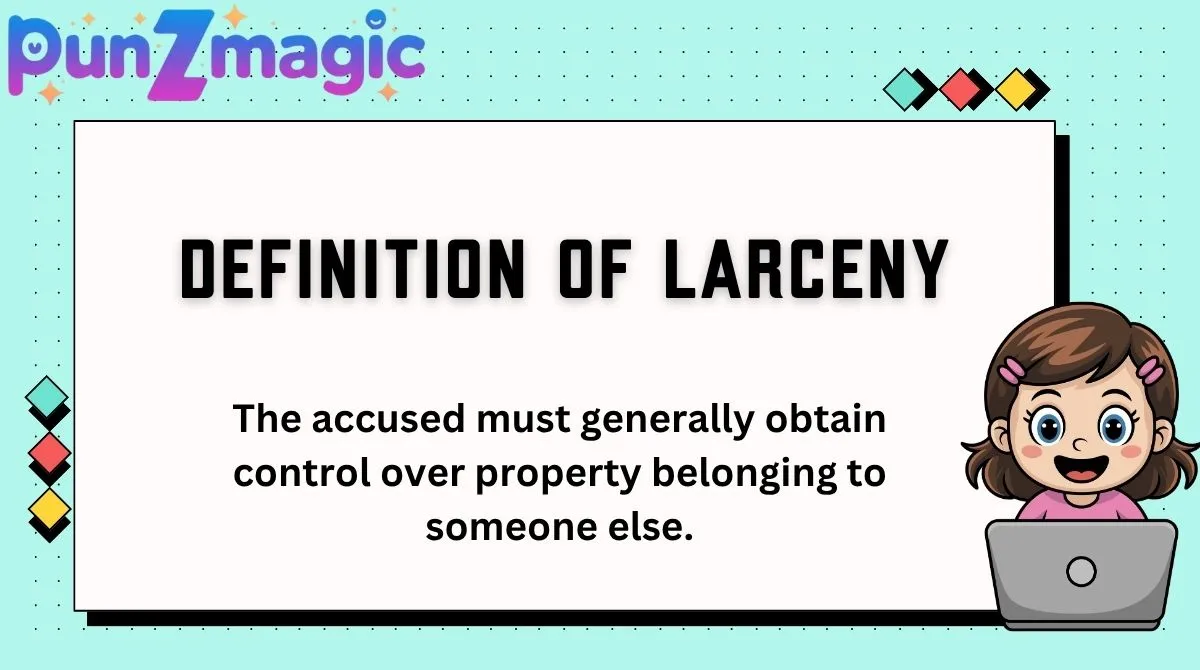
The definition of larceny is the unlawful taking and carrying away of another person’s property with the intent to permanently deprive the owner of it.
In simple terms, larceny means stealing someone else’s property. It is a legal term with roots in traditional common law, and its exact meaning can vary by jurisdiction.
Larceny usually involves property that belongs to someone else, an unauthorized taking, and an intent to keep the property from its owner.
Modern criminal laws in many places use broader theft statutes instead of the traditional term. Understanding larceny helps explain how the law distinguishes stealing from other property crimes.
1. What Is the Definition of Larceny?
The definition of larceny traditionally refers to the wrongful taking and carrying away of another person’s personal property, without permission and with the intent to permanently deprive the owner of it.
This definition contains several important ideas.
First, the property must generally belong to someone else. Second, the person accused of larceny must take control of it without legal permission. Third, there must usually be an intention to keep the property from its owner permanently.
For example, suppose someone sees a phone on a café table, takes it without permission, and keeps it because they intend to own it. Under traditional larceny principles, those facts may support a larceny charge.
The exact legal rules depend on the jurisdiction. Modern statutes may define theft differently and may combine several traditional property offenses.
2. What Does Larceny Mean in Simple Words?
In simple words, larceny means stealing property that belongs to another person.
Imagine that someone leaves a bicycle outside a store. Another person takes the bicycle without permission and rides away intending to keep it. That is a simple example of conduct that traditionally fits the concept of larceny.
Larceny is more than simply touching or moving someone else’s property. The law generally looks at the person’s intent and circumstances.
For example, picking up someone’s wallet to hand it to a police officer is very different from picking it up and deciding to keep the cash.
Common factors include:
- Property belonging to another person
- An unauthorized taking
- Movement or carrying away of the property
- Intent to permanently deprive the owner
- Lack of a legal right to take it
Because criminal law differs between jurisdictions, these traditional elements should not be treated as the exact test in every location.
3. What Are the Elements of Larceny?
Traditional larceny law is often explained through several required elements. These elements help courts determine whether particular conduct meets the legal definition.
Taking
The accused must generally obtain control over property belonging to someone else.
Carrying Away
Traditional larceny required some movement of the property. This movement could be very small. The important point was that the property was taken from its original position.
Personal Property
Traditional common-law larceny generally concerned personal property, such as money, jewelry, clothing, or electronics.
Property of Another
The property must generally belong to someone other than the accused. Ownership and possession can sometimes involve complex legal questions.
Without Permission
The taking must generally be unauthorized. If someone has lawful permission to use or possess an item, the situation may fall under a different legal rule.
Intent to Permanently Deprive
This is one of the most important ideas. Traditional larceny generally requires an intent to permanently deprive the owner of the property.
A person who takes an item intending to return it may not meet the traditional larceny requirement, although other offenses could potentially apply.
4. What Are Some Examples of Larceny?
Examples can make the legal concept easier to understand.
Example 1: Taking a wallet
A person finds a wallet on a desk and takes it home intending to keep the money and cards. This may fit the traditional concept of larceny.
Example 2: Stealing a laptop
Someone enters an office without permission and takes another person’s laptop, intending to sell it. The unauthorized taking and intent to permanently deprive the owner are important facts.
Example 3: Taking jewelry
A person secretly removes jewelry from someone else’s bedroom and keeps it. This may constitute larceny under a jurisdiction’s applicable theft law.
Example 4: Taking a bicycle
Someone takes a bicycle that belongs to another person and rides away with the intention of keeping it. This is another straightforward example of traditional larceny.
The details matter in every case. Not every dispute over property is automatically larceny.
5. What Is the Difference Between Larceny and Theft?
The words larceny and theft are closely related, but they are not always used in exactly the same way.
Larceny is a traditional legal term with specific common-law elements. Theft is often used as a broader modern term for unlawfully taking or obtaining another person’s property.
Many jurisdictions have replaced separate common-law offenses with statutes that simply define different forms of theft.
| Term | General meaning |
|---|---|
| Larceny | Traditional offense involving wrongful taking of another’s property |
| Theft | Common modern term for unlawful taking or obtaining property |
| Robbery | Theft involving force or threat of force |
| Burglary | Unlawful entry into a building or structure with the required criminal intent |
| Embezzlement | Fraudulent conversion of property that was lawfully entrusted to someone |
These categories can overlap in everyday language, but their legal elements are different.
For that reason, it is important to check the law of the specific jurisdiction when discussing an actual criminal case.
6. What Is the Difference Between Larceny and Robbery?
Larceny and robbery both involve taking property, but force or threats are the key distinction in traditional definitions.
Larceny generally involves taking property without the use of force against the victim.
Robbery traditionally involves taking property from a person or in their presence through force or intimidation.
For example, secretly taking a wallet from an unattended desk may fit traditional larceny.
If someone threatens another person and demands their wallet, the conduct may instead meet the definition of robbery.
The distinction matters because robbery is generally treated as a more serious offense due to the risk of violence or intimidation.
Again, modern criminal statutes vary, so the exact legal definitions depend on where the conduct occurred.
7. What Is the Difference Between Larceny and Burglary?
Larceny and burglary involve different basic ideas.
Larceny focuses on the unlawful taking of property.
Burglary traditionally focuses on unlawful entry into a building or structure with a required criminal intent. Modern burglary laws can be broader and vary significantly.
For example, imagine a person enters a store during business hours and secretly takes a laptop. The property-taking issue may involve theft or larceny.
Now imagine a person unlawfully enters a closed building at night intending to commit a crime inside. That may raise a burglary issue, even if they do not successfully take anything.
A person can potentially commit both burglary and theft-related offenses during the same incident.
The offenses focus on different conduct.
8. What Is the Difference Between Larceny and Embezzlement?
The major difference between traditional larceny and embezzlement is how the person originally obtained possession of the property.
In traditional larceny, the person wrongfully takes property from another’s possession.
In embezzlement, a person generally has lawful possession or control of someone else’s property and later fraudulently converts it for their own use.
Consider an employee who is given money to deposit into a company bank account.
If the employee is trusted with lawful possession of the money but secretly uses it for personal expenses, the conduct may raise an embezzlement issue.
The legal distinction can be technical. Courts may look closely at possession, authority, ownership, and intent.
9. What Is Petty Larceny and Grand Larceny?
Some legal systems historically divided larceny into categories based largely on the value of the property stolen.
Terms such as petty larceny and grand larceny have been used in some jurisdictions.
Petty larceny generally refers to theft involving property below a legally defined value threshold. Grand larceny generally refers to theft involving property meeting or exceeding a specified threshold or fitting another statutory category.
The exact dollar amounts and legal consequences vary by jurisdiction.
For example, one jurisdiction may classify a low-value theft as a misdemeanor, while theft above a certain value may be treated as a felony.
Other jurisdictions use different terminology, such as misdemeanor theft and felony theft.
Therefore, you should not assume that a particular dollar amount automatically determines the charge everywhere.
10. What Can Happen After a Larceny Charge?
The consequences of a larceny or theft charge depend on many factors.
Courts may consider the value and type of property, the person’s criminal history, the circumstances of the alleged offense, and the law of the jurisdiction.
Potential consequences can include:
- Fines
- Probation
- Restitution
- Community service
- A criminal conviction
- Incarceration in more serious cases
A court may also consider whether the property was recovered and whether the victim suffered financial loss.
Being accused of larceny is not the same as being found guilty. Criminal cases require the prosecution to meet the applicable legal burden of proof.
Because larceny laws differ between jurisdictions, anyone facing an actual charge should seek advice from a qualified lawyer familiar with the relevant local law.
FAQs
What is the simple definition of larceny?
Larceny traditionally means wrongfully taking and carrying away another person’s property with the intent to permanently deprive the owner of it.
Is larceny the same as theft?
They are closely related. Larceny is a traditional legal term, while theft is often used as a broader modern term. Many jurisdictions now use theft statutes instead of traditional larceny terminology.
What are the main elements of larceny?
Traditional larceny generally involves taking, carrying away, another person’s personal property, lack of permission, and intent to permanently deprive the owner.
What is the difference between larceny and robbery?
Traditional larceny does not require force or threats. Robbery generally involves taking property through force or intimidation.
What is the difference between larceny and burglary?
Larceny focuses on wrongfully taking property. Burglary generally focuses on unlawful entry into a building or structure with criminal intent, although modern definitions vary.
Is petty larceny a felony?
Not necessarily. The classification depends on the jurisdiction, value of the property, and applicable statute. In some places, lower-value theft is treated as a misdemeanor.
Can you be charged with larceny for taking something you planned to return?
Traditional larceny generally requires an intent to permanently deprive the owner. However, other criminal offenses may apply depending on the circumstances and local law.
Conclusion
The definition of larceny traditionally describes the wrongful taking and carrying away of another person’s property with the intent to permanently deprive the owner of it.
Key ideas include unauthorized taking, personal property, movement, and criminal intent. Larceny is closely related to theft but can be distinguished from offenses such as robbery, burglary, and embezzlement.
Because modern laws vary widely, the exact definition and penalties depend on the jurisdiction. Understanding the basic concept is useful, but an actual criminal case requires careful review of the specific law and facts.

I am Elina James, a passionate wordplay lover and the creative mind behind PunzMagic. I enjoy turning simple words into clever puns that make people smile, laugh, and share joy with others.