Third Person Limited: Point of View Definition and Examples For 2026
Third person limited point of view is a way of telling a story through the eyes of one character. The narrator uses words like he, she, and they to describe events.
Readers learn what this character thinks, feels, and knows, but they do not know the private thoughts of every other character.
This point of view helps readers feel close to the main character while keeping some facts hidden.
Writers use it to build suspense, show emotions, and make stories more engaging. Understanding this style can help you read stories with greater care and write better fiction.
1. What Is Third Person Limited Point of View?
Third person limited point of view is a storytelling style in which the narrator follows one character’s thoughts, feelings, and experiences. The narrator tells the story using third-person pronouns, such as he, she, it, and they.
The word limited is important. It means readers have access to the inner world of one main character, or sometimes one character at a time. They do not know what every person in the story thinks or feels.
For example:
Emma walked into the dark room. Her hands shook as she reached for the light switch. She hoped the strange noise had come from the window.
This example shows Emma’s actions and feelings. Readers know she is scared and what she hopes will happen. However, they do not know what caused the noise.
The narrator stays close to Emma’s experience. Readers discover the truth as she does.
Writers often choose this point of view because it creates a strong bond between the reader and the main character. It also allows the writer to hide information and reveal it at the right time.
2. Key Features of Third Person Limited Point of View
Third person limited has several features that make it different from other storytelling styles.
One character’s perspective: The story mainly follows one character’s experiences and inner thoughts. Readers learn about events through that character’s point of view.
Third-person pronouns: The narrator uses words like he, she, they, and the character’s name instead of I or we when telling the story.
Limited knowledge: The narrator does not share the private thoughts of every character. Readers only learn what the viewpoint character can know or observe.
Emotional connection: Readers can understand the main character’s fears, hopes, doubts, and dreams. This helps them care about what happens.
Room for mystery: Other characters may hide their true feelings or plans. Readers must use clues to understand them.
Here is a simple example:
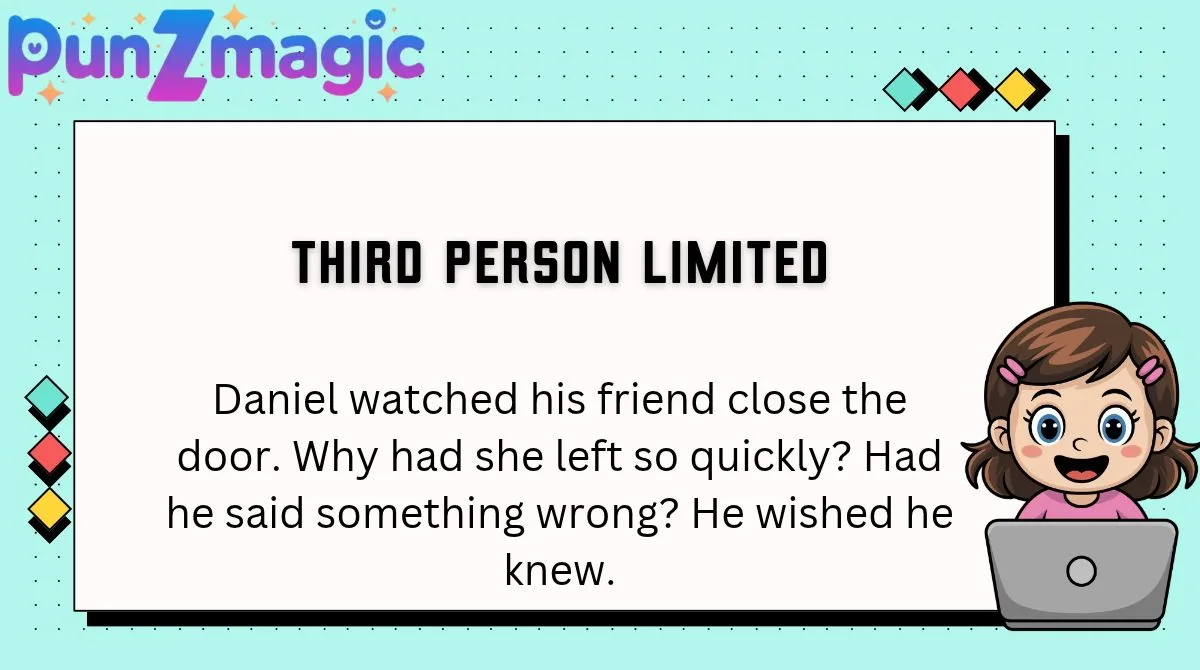
Daniel watched his friend close the door. Why had she left so quickly? Had he said something wrong? He wished he knew.
Readers understand Daniel’s confusion. However, they do not know why his friend left. The story stays within Daniel’s knowledge.
These features make third person limited useful for stories about personal growth, friendship, family, adventure, and mystery.
3. How Does Third Person Limited Work?
Third person limited works by keeping the narration close to one character’s experience. The narrator can describe what the character sees, hears, thinks, remembers, and feels.
However, the narrator should not reveal information that the viewpoint character could not know unless the story clearly changes perspective.
Consider this example:
Lily entered the classroom and saw Mark sitting alone. He looked down at his book when she approached. Lily wondered if he was upset with her.
The reader knows what Lily sees and thinks. Mark’s behavior is visible, but his private thoughts remain unknown.
Maybe Mark is upset. Maybe he is tired. Maybe he is shy. Lily does not know the answer, so the reader does not know it either.
This creates a natural sense of curiosity.
A writer can also use the character’s memories and beliefs to shape the narration.
For example:
The old house seemed colder than Lily remembered. She had loved visiting it as a child, but now every creaking floorboard made her uneasy.
The description reflects Lily’s feelings. Another character might see the house as warm and welcoming.
In this way, the viewpoint character affects how readers experience the story. The same place, event, or person can feel different depending on whose perspective the writer follows.
4. Third Person Limited Point of View Examples
Examples make this concept easier to understand. Here are several short passages that show how writers can use third person limited in different situations.
Example 1: Fear
Jason stepped into the basement. The air smelled damp, and a soft tapping came from behind the wall. His heart raced. He wanted to leave, but he needed to find his missing dog.
The reader knows Jason feels afraid. The source of the tapping remains unknown.
Example 2: Happiness
Amira opened the letter and read the first line. She smiled so widely that her cheeks hurt. At last, she had been accepted into the school she dreamed of attending.
Readers experience the good news through Amira’s reaction.
Example 3: Confusion
Noah saw his sister whisper to their father. Both of them stopped talking when he entered the kitchen. He wondered what they were hiding.
The reader shares Noah’s questions but does not know what the other characters discussed.
Example 4: Sadness
Ella placed the empty picture frame on her desk. She missed her grandmother’s warm smile and the stories she used to tell. The room felt too quiet without her.
The passage focuses on Ella’s memories and grief.
Example 5: Suspense
Oliver heard footsteps outside his bedroom. He held his breath and watched the door handle turn. Someone was coming in, but he could not tell who.
The reader knows what Oliver knows. This limited information makes the moment tense.
Each example keeps the reader close to one character. The narrator shares that character’s inner world without revealing every other person’s thoughts.
5. Third Person Limited vs. Other Points of View
Third person limited is one of several common ways to tell a story. Understanding the differences can help writers choose the best style for their work.
| Point of view | Main features | Example |
|---|---|---|
| First person | The narrator tells the story as a character using I or we. | I opened the door and felt afraid. |
| Second person | The narrator addresses the reader as you. | You open the door and feel afraid. |
| Third person limited | The narrator uses he, she, or they and follows one character’s inner experience. | Maya opened the door. She felt afraid. |
| Third person omniscient | The narrator can reveal the thoughts and feelings of many characters. | Maya felt afraid, while Ben secretly hoped she would leave. |
| Third person objective | The narrator reports observable actions and speech without directly revealing private thoughts. | Maya opened the door. Ben stepped back. |
The key difference is how much the narrator knows and shares.
In first person, the narrator is usually a character telling their own story. In third person limited, the narrator speaks about a character but stays close to that character’s perspective.
Third person omniscient gives readers a wider view. It can reveal what several characters think, even when they do not share their feelings with one another.
Third person objective focuses on what can be seen or heard. It leaves readers to guess what characters feel.
For many novels, third person limited offers a useful balance. It gives readers access to a character’s emotions while allowing the writer to maintain mystery and control the flow of information.
6. Benefits of Using Third Person Limited Point of View
Writers use third person limited because it offers several storytelling benefits.
1. It builds an emotional bond. Readers can understand the main character’s fears, hopes, and struggles. This makes it easier to care about the character’s choices.
2. It creates suspense. Readers only know what the viewpoint character knows. Hidden facts can keep them interested and encourage them to continue reading.
3. It makes characters feel real. The story can show how a character’s memories, beliefs, and feelings shape their view of the world.
4. It gives writers flexibility. Writers can describe a character’s thoughts while still using an outside narrator. This offers more freedom than a strict first-person account.
5. It supports character growth. Readers can follow changes in a character’s beliefs, feelings, and actions. They can see how new experiences affect the character.
6. It keeps the story focused. Staying with one character helps the writer avoid too many side stories or sudden changes in attention.
For example, imagine a story about a student who is afraid of speaking in public. By following the student’s thoughts, the writer can show every worry before a speech and every small victory afterward.
Readers experience the student’s growth from the inside. This makes the final success more meaningful.
However, this point of view also has limits. The writer cannot freely reveal the secret thoughts of other characters without changing the viewpoint. That restriction can make some scenes harder to write, but it can also make the story more powerful.
7. How to Write in Third Person Limited Point of View
Writing in third person limited becomes easier when you follow a few clear steps.
Step 1: Choose a viewpoint character.
Decide whose experiences will guide the scene. Ask yourself which character has the most important feelings or information in that moment.
Step 2: Use third-person pronouns.
Refer to the character by name or use he, she, or they. Avoid switching to I unless a character speaks or thinks directly in first person.
Step 3: Show the character’s inner thoughts.
Let readers understand the character’s worries, hopes, memories, and choices.
For example:
Ben looked at the test paper. He had studied all night, but the first question made no sense. What if he failed again?
Step 4: Describe what the character can notice.
Include sights, sounds, smells, and other details that the character can experience.
Step 5: Keep other characters’ thoughts private.
You can show their actions, facial expressions, and words. Let readers guess what those actions mean.
Step 6: Check for viewpoint shifts.
Read each paragraph and ask whether the information belongs to the viewpoint character’s experience.
Use this short checklist while editing:
- Does the scene follow one character’s perspective?
- Are the character’s thoughts and feelings clear?
- Does the narrator avoid revealing unknown facts?
- Are descriptions shaped by the character’s experience?
- Are changes in viewpoint clear to the reader?
These steps can help you create a clear and steady point of view. With practice, readers will feel close to the character without becoming confused about what the narrator knows.
8. Common Mistakes to Avoid
Even experienced writers can make mistakes when using third person limited. The most common problem is sharing information that the viewpoint character cannot know.
Mistake 1: Revealing another character’s private thoughts
Incorrect:
Lucy felt nervous. Across the room, Peter worried that Lucy would discover his secret.
The sentence moves from Lucy’s feelings to Peter’s private thoughts. If Lucy is the viewpoint character, she cannot know Peter’s thoughts directly.
Better:
Lucy felt nervous. Across the room, Peter kept glancing at the locked drawer. She wondered why he seemed so uneasy.
Now the reader sees Peter’s behavior through Lucy’s eyes.
Mistake 2: Changing viewpoint without warning
A writer may begin a scene inside one character’s mind and then suddenly move into another character’s mind. This can confuse readers.
To avoid this, stay with one viewpoint character throughout a scene. If you want to change perspectives, use a clear scene or chapter break when possible.
Mistake 3: Sharing facts the character cannot know
Incorrect:
Sarah walked down the hall, unaware that a stranger was waiting behind the door.
If Sarah cannot see or otherwise learn about the stranger, this statement gives readers information beyond her awareness.
Better:
Sarah walked down the hall. A faint sound came from behind the door, but she could not tell what had caused it.
This version keeps the information within Sarah’s experience.
Mistake 4: Using only actions and no inner feelings
Third person limited is not just a record of what a character does. It can also reveal thoughts, feelings, and memories.
Instead of writing, Tom sat down and looked at the clock, try:
Tom sat down and looked at the clock again. His interview began in five minutes, and he was sure he had forgotten something important.
The second version creates a stronger connection with Tom.
Mistake 5: Telling readers what a character cannot know
Avoid giving the viewpoint character certain knowledge about another person’s motives without evidence. Show what the character observes and let them form an opinion.
A character can make a wrong guess. In fact, those mistakes can make the story more realistic.
9. Can Third Person Limited Have Multiple Viewpoint Characters?
Yes. A novel can use third person limited while following several characters. The key is to keep each scene’s viewpoint clear.
For example, a story might follow both Anna and David. One chapter could show Anna preparing for a journey. The next could follow David as he searches for her.
In Anna’s chapter, readers learn her thoughts and feelings. In David’s chapter, readers learn his inner experience instead.
This approach is often called multiple third-person limited point of view.
It allows readers to understand different sides of the same event. It can also build suspense because one character may know something that another does not.
However, writers should avoid switching between characters’ minds too quickly within a scene. This is sometimes called head-hopping. It can make readers lose track of whose perspective they are following.
For example, a clear sequence might look like this:
- Chapter 1 — Anna: She worries that David will not return.
- Chapter 2 — David: He struggles to reach Anna before nightfall.
- Chapter 3 — Anna: She hears a knock and hopes it is David.
Each chapter follows one character’s thoughts. Readers gain a broader view of the story without losing the close focus of third person limited.
If you are new to writing fiction, it may be easier to begin with one viewpoint character. Once you understand the technique, you can add other viewpoints when the story needs them.
10. When Should You Use Third Person Limited Point of View?
Third person limited works well when a story depends on one character’s feelings, discoveries, or personal growth.
It is especially useful for these types of stories:
Mystery and thriller: Readers discover clues alongside the main character. Keeping important facts hidden can build tension.
Fantasy and adventure: Readers explore unfamiliar worlds through a character’s experiences. The character’s fears and discoveries help make the setting feel real.
Romance: Readers can follow one character’s hopes, doubts, and feelings about a relationship. The other person’s intentions can remain unclear until later.
Young adult fiction: This style can help readers connect with a young character as they face school, friendship, family, and personal challenges.
Coming-of-age stories: Readers can see how a character’s thoughts and beliefs change over time.
Emotional dramas: The viewpoint can make grief, joy, regret, and hope feel personal and meaningful.
Consider a mystery story about a missing necklace. If the story follows only the detective, readers learn about each clue as the detective finds it. They cannot know the thief’s thoughts unless the detective discovers evidence or the story changes viewpoint.
This makes the reader an active partner in solving the mystery.
By contrast, a story that needs to show the secret thoughts of every character may work better with third person omniscient or several clearly separated limited viewpoints.
The best choice depends on what you want readers to know, feel, and discover. Choose the point of view that best supports the story’s main purpose.
FAQs
1. What is third person limited point of view in simple words?
Third person limited is a way of telling a story through one character’s thoughts and feelings. The narrator uses words like he, she, and they but does not reveal what every character thinks.
2. What is an example of third person limited point of view?
Jack opened the letter. His hands shook as he read the news. He hoped his family would understand.
Readers know what Jack does, feels, and hopes. They do not know how his family will react.
3. What is the difference between third person limited and omniscient?
Third person limited follows one character’s inner experience at a time. Third person omniscient can reveal the thoughts and feelings of many characters, even when they are apart.
4. Does third person limited use the word “I”?
The narrator usually uses he, she, they, or character names instead of I. However, a character may use I in dialogue or in a direct thought.
5. Can third person limited show the thoughts of other characters?
Not directly while staying within one character’s viewpoint. The narrator can show another character’s words, actions, and expressions, but the viewpoint character cannot know that person’s private thoughts without some form of evidence.
6. Is third person limited better than first person?
Neither style is always better. Third person limited gives writers some distance from the character while still showing inner feelings. First person can create a very direct connection by letting the narrator tell the story in their own voice.
7. Can a story switch between third person limited characters?
Yes. A story can follow different characters in separate scenes or chapters. Each section should make it clear whose thoughts and feelings readers can access.
Conclusion
Third person limited point of view lets readers experience a story through one character’s thoughts, feelings, and knowledge.
It uses third-person pronouns while keeping the narrator’s inner focus limited to the chosen character. This style can build suspense, deepen emotions, and make characters feel real.
Writers can use it in many genres, from romance to mystery and fantasy.
To use it well, choose a clear viewpoint character, show what they know, and avoid revealing other characters’ private thoughts without a clear change in perspective.
With practice, this technique can make your storytelling more focused and engaging.

I am Elina James, a passionate wordplay lover and the creative mind behind PunzMagic. I enjoy turning simple words into clever puns that make people smile, laugh, and share joy with others.